Per User, Per Device or By the Hour? Why the Traditional MSP Pricing Model May Be Changing
The End of Per-User and Per-Device IT? Why Businesses Are Switching to Flexible Block-Hour Support
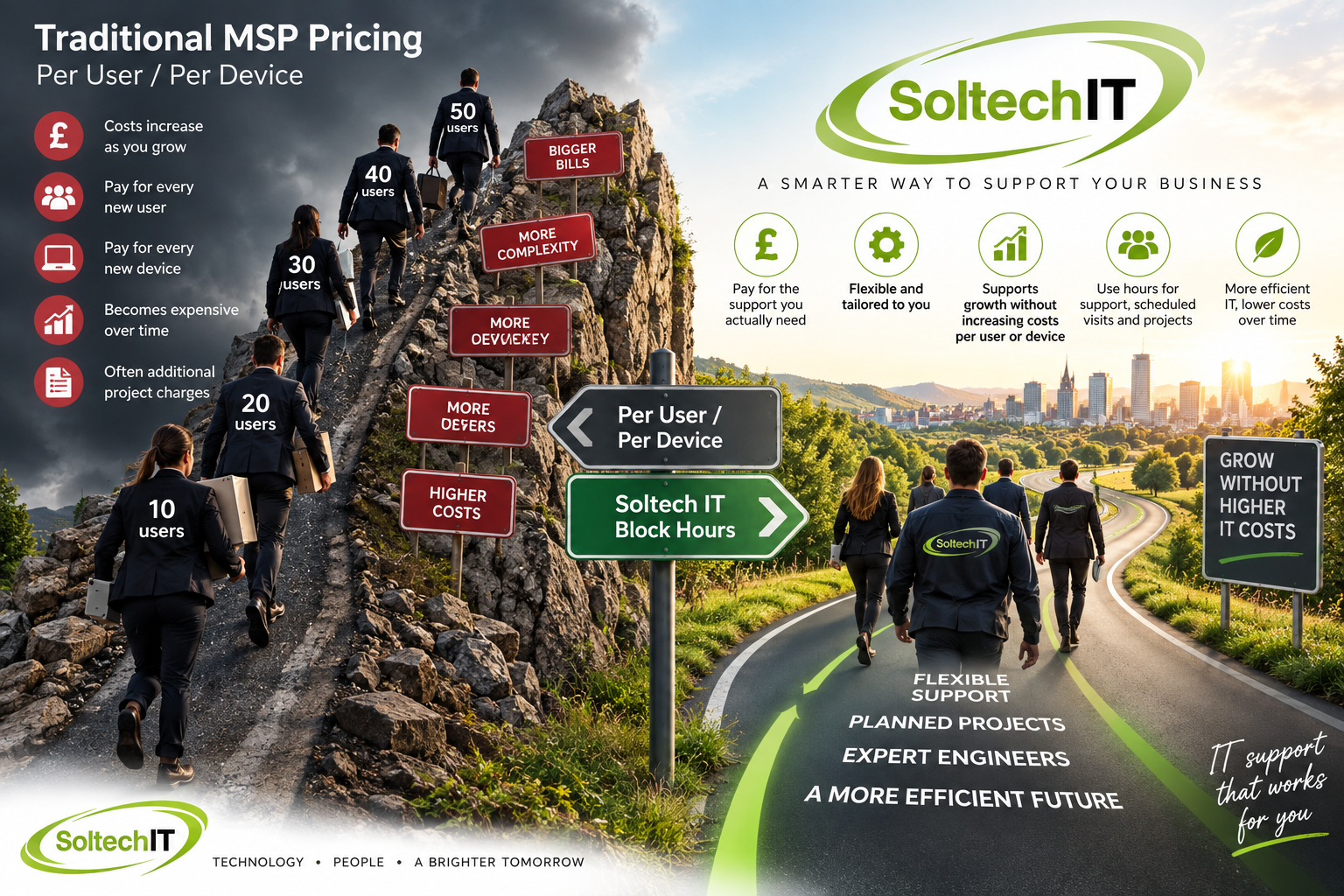
The End of Per-User IT? Why Businesses Are Switching to Flexible Block-Hour Support
For years, the standard way of buying IT support has been relatively simple: pay your IT provider a fixed monthly fee for every user or every device they support.
On the surface, this makes sense.
You have 20 employees, so you pay for 20 users. You have 30 computers, so you pay for 30 devices. If your business grows to 30 employees and 45 computers, your IT support bill grows with it.
It is predictable, easy to budget and has become the dominant pricing model used by many Managed Service Providers (MSPs).
But technology is changing.
Artificial intelligence, automation, remote monitoring and management platforms, automated patching, endpoint management and increasingly sophisticated cloud services are changing the amount of human intervention required to manage a modern IT environment.
And that raises an important question:
Should your IT support costs automatically increase every time your business grows?
At Soltech IT, we don't think they necessarily should.
Our approach is different. Rather than charging businesses based on the number of users or devices they have, we provide IT support through pre-purchased blocks of engineering time.
We believe this can provide a fairer and, importantly, more sustainable pricing model for growing businesses.
The traditional MSP pricing model
The majority of managed IT providers operate on some variation of a per-user or per-device model.
A business might pay, for example, a fixed amount per employee every month.
As the business grows, the IT bill grows:
10 employees = 10 charges
25 employees = 25 charges
50 employees = 50 charges
The same principle applies to per-device pricing.
Buy another 10 laptops and the monthly support cost can increase.
This model has some obvious advantages. Costs are predictable, and businesses know roughly what their monthly IT expenditure will be.
But there is another side to the equation.
The cost increases because you have grown.
And in our view, that deserves closer examination.
Should IT support really cost more because your business is growing?
Imagine a business has 25 employees and pays its MSP £60 per user per month.
That's £1,500 per month.
The business grows successfully and employs another 10 people.
The IT support bill now becomes £2,100 per month.
Nothing has necessarily gone wrong.
The IT infrastructure should have become better during that period.
The business may have:
- moved more services into Microsoft 365;
- replaced old computers;
- introduced modern endpoint management;
- implemented automated patching;
- improved cyber security;
- deployed MFA;
- upgraded its network;
- replaced legacy applications;
- introduced better monitoring;
- automated software deployment;
- standardised hardware.
In other words, the IT environment could actually require less manual intervention per employee than it did several years ago.
Yet under a per-user pricing model, the IT support bill still rises because the company has hired more people.
That is the part of the traditional model we believe businesses should question.
Automation is changing the amount of IT work required
Modern IT management is very different from the IT environment of 10 or 15 years ago.
Historically, an IT engineer might have spent significant amounts of time manually performing tasks such as:
- installing software;
- applying Windows updates;
- checking devices;
- installing patches;
- updating applications;
- monitoring hardware;
- configuring computers;
- deploying security software;
- checking whether machines were compliant;
- carrying out routine maintenance.
Much of this can now be automated.
Modern Remote Monitoring and Management (RMM), Microsoft Intune, endpoint management, security platforms and other automation technologies can carry out many routine tasks without an engineer having to manually intervene.
Artificial intelligence is accelerating this change further.
AI and automation can help identify problems, analyse alerts, automate repetitive processes, assist with troubleshooting and reduce the amount of human intervention required for routine IT management.
That doesn't mean engineers are no longer required.
Quite the opposite.
Good IT engineers are still essential.
But their time can increasingly be focused on the things where human expertise adds the most value:
- resolving complex technical problems;
- designing infrastructure;
- cyber security;
- projects;
- migrations;
- strategic advice;
- business continuity;
- major incidents;
- complex Microsoft 365 issues;
- network problems;
- integrating new technology.
The question is therefore:
Should businesses continue paying an MSP a fee based primarily on the number of users or devices, even as the amount of human time required to manage those users and devices falls?
We believe there is a strong argument for reconsidering the model.
Per-device pricing can become particularly expensive
Per-device pricing has an obvious attraction.
If you have 20 computers, you pay for 20 computers.
But what happens when your business grows?
Suppose you have 20 employees and 25 devices.
You recruit five new employees.
You now have 25 employees and perhaps 32 devices.
Under a per-device model, your IT support cost increases simply because you have purchased more computers.
And that's before considering the other technology associated with growth.
New employees may require:
- laptops;
- desktop computers;
- Microsoft 365 accounts;
- mobile devices;
- additional security licences;
- additional endpoint licences;
- additional software;
- additional peripherals.
The business is already spending money to grow.
Why should its IT support bill automatically rise at the same rate?
Growth should be a positive thing.
IT shouldn't become a tax on expansion.
Per-user pricing has the same problem
Per-user pricing solves some of the problems associated with per-device pricing.
Instead of charging for every computer, the MSP charges for every employee.
But the fundamental issue remains.
If you employ 50 people instead of 40, you pay for 10 additional users.
And if you employ 100 rather than 50, you potentially pay twice as much.
This can make IT support a variable cost directly linked to headcount.
For some organisations that may be perfectly appropriate.
But for growing businesses, we think it is worth asking whether there is a better approach.
What if better IT should actually reduce your support requirement?
This is where Soltech's philosophy differs.
We believe a good IT provider should not simply deal with IT problems.
They should work to remove the reasons those problems occur in the first place.
For example, if users repeatedly experience the same problem, the answer shouldn't necessarily be to keep resolving the same support ticket.
The better question is:
Why is this happening?
- Perhaps the software needs updating.
- Perhaps a configuration needs changing.
- Perhaps a security policy needs implementing.
- Perhaps the hardware is approaching end of life.
- Perhaps users need training.
- Perhaps an application needs replacing.
- Perhaps automation can prevent the issue from happening altogether.
Solving the underlying problem can reduce the amount of IT support required in the future.
That is where a good IT provider earns its money.
From reactive IT support to proactive IT improvement
There is an important distinction between providing IT support and improving IT.
A provider that simply resolves tickets can potentially remain busy forever.
A provider that fixes the underlying causes of those tickets should gradually reduce the amount of unnecessary support.
For example:
Problem: Users repeatedly report that their computers are slow.
Traditional approach: Fix the computer.
Better approach: Identify why the computers are slow and address the underlying issue.
- Perhaps the machines are old.
- Perhaps there is insufficient memory.
- Perhaps applications are poorly configured.
- Perhaps security software is creating conflicts.
- Perhaps the business needs a standardised hardware platform.
Once the underlying issue is resolved, the number of future support calls can fall.
That's good IT.
And that's what businesses should want from their IT provider.
The Soltech IT approach: buy engineering time, not users
This is why Soltech IT has chosen a different approach for businesses that don't require a traditional all-you-can-eat managed service.
Rather than charging a fixed amount for every user or device, businesses can purchase blocks of IT engineering time.
The principle is straightforward.
You purchase an agreed amount of support time and use that time when you need it.
That could include:
- technical support;
- troubleshooting;
- Microsoft 365 assistance;
- network support;
- computer problems;
- user support;
- configuration;
- technical advice;
- software issues;
- infrastructure support;
- general IT engineering.
The important difference is that the number of people in your organisation doesn't automatically determine your support bill.
If you employ another five people, your IT support cost doesn't automatically increase simply because you have five additional users.
If you buy another ten computers, you don't automatically create ten additional monthly support charges.
Instead, you pay for the engineering time you actually need.
What happens when automation reduces the amount of support required?
This is perhaps the most interesting part of the model.
Imagine that your IT environment improves.
- Your devices are newer.
- Your software is standardised.
- Patching is automated.
- Microsoft 365 is properly configured.
- Security policies are enforced.
- Endpoint management is automated.
- Users are better trained.
- Recurring technical problems have been eliminated.
- AI and automation deal with an increasing number of routine tasks.
Your requirement for human IT engineering time will reduce.
Under a traditional per-user or per-device model, your monthly bill may remain the same — or increase if your organisation has grown.
Under an hourly or block-time model, you can potentially consume fewer engineering hours.
Your IT costs can therefore fall as your IT environment becomes more efficient, whilst business growth doesn't mean IT costs automatically increase.
We think that is a much healthier relationship between an IT provider and its customer.
A simple example
Consider a growing business with 30 employees.
Under a hypothetical per-user MSP contract at £60 per user per month:
30 users × £60 = £1,800 per month
The business grows to 50 employees.
50 users × £60 = £3,000 per month
The business has grown by 67%.
Its IT support bill has also grown by 67%.
Now consider a business using an IT support model based on engineering time.
The business might initially require 30 hours of engineering support.
As the IT environment becomes better managed and more automated, that requirement might fall to 20 hours.
Even if the business grows from 30 to 50 employees, the underlying IT environment may not require a corresponding 67% increase in engineering time.
The exact figures will obviously vary from business to business.
But the principle is important:
IT workload does not necessarily increase in direct proportion to headcount.
And we don't believe IT support pricing should automatically assume that it does.
But isn't unlimited IT support safer?
One of the strongest arguments for traditional managed service contracts is the promise of "unlimited IT support." You pay a fixed monthly fee and don't have to worry about how many support tickets you raise.
But unlimited doesn't necessarily mean better value.
At Soltech IT, we believe your IT provider should get the level of support right for your organisation, rather than automatically charging for every user or device. Our block-hours model gives businesses the flexibility to purchase the engineering time they actually need, with the ability to add smaller blocks of time if additional support is occasionally required. This means you still only pay for the support you need, and never overpay.
Those hours can also be used flexibly. They can cover regular scheduled visits, day-to-day support, technical consultancy and planned project work, rather than projects automatically becoming additional charges on top of your support contract.
This means your support agreement can be tailored around your business and its future requirements. If you have a project coming up, time can be allocated for it. If you need regular on-site support, that can be built in. If you need a little more time one month, you can purchase it without necessarily committing to a permanently more expensive support package.
Most importantly, as your IT environment becomes more efficient through automation, better systems and the elimination of recurring problems, your requirement for engineering time may actually reduce.
We believe that's how IT support should work: the amount you pay should reflect the support and expertise you actually need, rather than automatically increasing every time your business adds another employee or device.
The future of IT support isn't necessarily more engineers
Technology is becoming increasingly automated.
That's not something businesses should be afraid of.
It's an opportunity.
The role of an IT provider is evolving from spending time performing repetitive tasks towards:
automation + expertise + security + strategy + problem solving.
The best IT providers should be using technology to make themselves more efficient.
And customers should ultimately benefit from that efficiency.
If automation means an engineer can achieve in 30 minutes what previously took two hours, the customer shouldn't necessarily need to pay for two hours simply because that's how IT support used to work.
Technology should make IT support more efficient, not simply more profitable for the provider.
IT shouldn't become a cost of growth
For many businesses, growth means additional employees, offices, computers, software and technology.
All of those things cost money.
But IT support shouldn't necessarily increase at the same rate.
If an organisation grows from 20 to 40 employees, that doesn't automatically mean that its underlying IT problems double.
A well-designed IT environment can actually become more efficient as it grows.
Standardised hardware, cloud services, automation, centralised management and better security can all reduce the amount of manual intervention required.
That's why we believe IT support should be considered differently.
Growth should increase the productivity of your IT investment — not simply the size of your IT support bill.
The Soltech IT philosophy
At Soltech IT, we believe our job is not simply to keep fixing the same problems.
Our job is to help businesses build a better IT environment.
That means identifying recurring problems, improving infrastructure, introducing automation, strengthening cyber security and making technology work more effectively.
The better we do that, the less unnecessary engineering time should be required.
And that's exactly why we believe our block-hour approach makes sense for many businesses.
You pay for the IT expertise you need, rather than paying indefinitely for every employee or device you have.
As your business grows, your IT environment should become more efficient.
As automation improves, the amount of routine IT work should reduce.
And as recurring problems are solved, you should need less reactive support.
That's how IT support should work.
Not more expensive because you've grown, but less expensive because your IT has improved.
Is a block-hours IT support model right for your business?
If you're currently paying an MSP on a per-user or per-device basis, it may be worth looking at what you're actually receiving for that monthly fee.
Ask yourself:
- How much of the service do we actually use?
- How much of our IT is now automated?
- Are we paying more every time we recruit?
- Are we paying more every time we purchase additional equipment?
- Does our IT provider actively reduce recurring problems?
- Are we paying for unlimited support that we rarely use?
- Could engineering time be purchased more efficiently?
- Is our IT provider helping us reduce our long-term IT costs?
- Are we paying for onsite engineering visits or project work time as an additional cost?
There isn't one pricing model that is right for every organisation.
But as AI, automation and cloud technology continue to change the IT industry, businesses should be questioning whether traditional per-user and per-device pricing still represents the best value.
At Soltech IT, we believe that for many growing businesses, paying for the engineering time you actually need can be a more transparent, flexible and cost-effective way of buying IT support.
If you'd like to compare your current IT support costs with the Soltech IT approach, speak to our team.
Sometimes the best way to reduce your IT costs isn't to negotiate a cheaper price. It's to change the way you pay for IT.
Netitude, BOM IT, SoVision, WestSpring IT, EvolvIT
Get in touch